Business Debt Consolidation Loan: How to Combine Business Debt Without Making It Worse
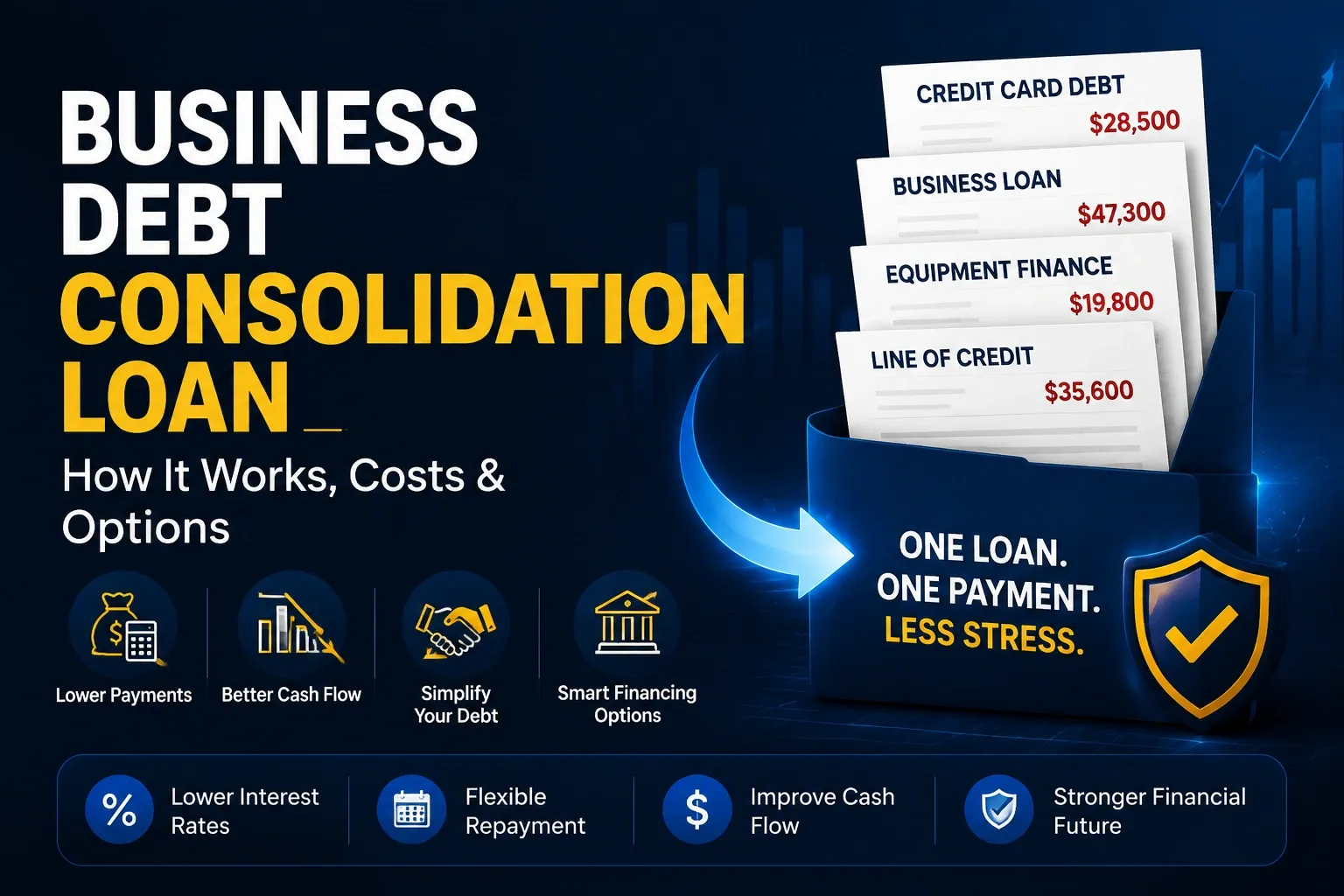
Managing one business loan is usually straightforward. Managing three loans, two business credit cards and a line of credit—each with a different payment date, rate and repayment schedule—is another story.
A business debt consolidation loan lets you replace multiple business debts with one new loan. Ideally, the new financing gives you a lower borrowing cost, a more manageable payment schedule, or both.
But there is an important word in that sentence: ideally.
Business debt consolidation does not automatically save money. A lower monthly payment can actually cost you more if the new loan stretches repayment over several additional years.
This guide explains how business debt consolidation works, what lenders look for, when an SBA loan may be an option, how to calculate whether consolidation actually saves money, and when taking another loan is probably the wrong move.
Quick Answer: A business consolidation loan can make sense when the new loan replaces several existing business debts with better overall terms. Don’t compare monthly payments alone—compare APR, fees, repayment term and total dollars repaid.
What Is a Business Debt Consolidation Loan?
A business debt consolidation loan is financing used to pay off several existing business debts.
Instead of making payments to multiple creditors, you use the proceeds of the new loan to clear eligible balances and then repay the new lender.
For example, a business might consolidate:
- Business credit card balances
- Business term loans
- Business lines of credit
- Short-term business loans
- Certain business cash advances
- Equipment-related debt
- Other eligible commercial obligations
Chase describes a business consolidation loan as a way of rolling multiple loans or cash advances into one loan, while noting that the new terms are not automatically better.
SoFi similarly describes business debt consolidation as combining multiple business debts into one loan and notes that businesses may be able to use ordinary bank, credit-union or online business financing even when a lender doesn’t market a product specifically called a “debt consolidation loan.”
That distinction matters.
“Business consolidation loan” isn’t always a separate loan product
You may search Google for:
- business debt consolidation loan
- business consolidation loan
- commercial debt consolidation
- small business debt consolidation loan
- consolidate business loans
But many lenders don’t have a product with one of those exact names.
Instead, they may offer a normal business term loan that permits refinancing existing business debt.
Chase, for example, explicitly states that it does not offer a separate business debt consolidation product even though its educational guidance explains how consolidation works.
So when comparing lenders, the more useful question is:
“Can this loan be used to refinance or pay off my existing business debt?”
How Business Debt Consolidation Works
The basic process is simple.
Suppose your company currently has:
| Existing Debt | Balance |
|---|---|
| Business credit card | $18,000 |
| Short-term business loan | $32,000 |
| Business line of credit | $20,000 |
| Equipment loan | $10,000 |
| Total debt | $80,000 |
You apply for a new $80,000 business loan.
If approved, the proceeds are used to repay the eligible existing debts.
Instead of managing four lenders, you now have:
BEFORE

Credit Card ───────┐
Term Loan ─────────┤
Line of Credit ────┼──► Multiple payments
Equipment Loan ────┘


AFTER

Consolidation Loan ───► One payment
The administrative benefit is obvious.
The financial benefit is not.
Whether consolidation is a smart decision depends on the numbers attached to that new loan.
Business Debt Consolidation vs. Business Debt Refinancing
These terms are often used interchangeably, but they aren’t exactly the same.
| Business Debt Consolidation | Business Debt Refinancing | |
|---|---|---|
| Main purpose | Combine multiple debts | Replace an existing debt |
| Number of existing debts | Usually two or more | Can be only one |
| New financing | One larger loan | Replacement loan |
| Goal | Simplify payments and potentially improve terms | Improve terms on an existing loan |
| Example | Replace three loans with one | Replace one 20% loan with a 12% loan |
The core difference is how many debts are being replaced.
Refinancing can involve a single existing loan. Consolidation generally refers to combining multiple obligations.
That distinction is also reflected in current business-finance guidance from SoFi and other lending resources.
In practice, however, lenders may use the terms loosely.
Focus on the economics of the transaction rather than the label.
Why Would a Business Consolidate Debt?
There are four major reasons.
1. Lower the borrowing cost
This is usually the strongest reason to consolidate.
Imagine your business took several forms of financing during a difficult period when your credit was weaker.
Two years later:
- Revenue has increased.
- Cash flow is more predictable.
- Your credit profile has improved.
- The business has a longer operating history.
You may now qualify for financing on better terms.
Replacing expensive debt with less expensive debt can reduce interest expense.
2. Reduce monthly cash-flow pressure
A consolidation loan may spread repayment over a longer period, reducing the required monthly payment.
That can free cash for:
- Payroll
- Rent
- Inventory
- Marketing
- Supplier payments
- Taxes
- Emergency expenses
But this advantage needs to be evaluated carefully.
Important Warning: A lower monthly payment does not necessarily mean a cheaper loan. Extending the repayment period can lower your payment while increasing the total interest you pay.
SoFi specifically warns that extending the repayment period can reduce monthly payments while increasing total interest expense.
3. Replace frequent payments
Some short-term business financing requires payments:
- Daily
- Several times per week
- Weekly
Replacing frequent withdrawals with one predictable monthly payment can improve cash-flow planning.
4. Simplify debt management
It is surprisingly easy for a growing company to accumulate several financing products.
One loan might be due on the 5th.
Another auto-debits every Friday.
Two cards have different statement dates.
A line of credit has a variable balance.
Consolidation can reduce the number of moving pieces.
That doesn’t directly reduce debt, but it can make the debt easier to manage.
When Business Debt Consolidation Actually Saves Money
This is where things get interesting.
The easiest mistake is comparing only interest rates.
You need to compare total cost.
A good consolidation offer should be evaluated using at least these five numbers:
- Remaining balance on your current debts
- Current APRs or equivalent borrowing costs
- Remaining repayment periods
- Prepayment or payoff fees
- APR, fees and term of the new loan
Example: Consolidation that saves money
Assume a business has $80,000 of debt that, for this simplified example, carries an effective 25% annual rate and would otherwise be repaid over the next 36 months.
Now assume the business qualifies for an $80,000 consolidation loan at 13% over the same 36-month period with no additional fees.
| Existing Debt | New Consolidation Loan | |
|---|---|---|
| Balance | $80,000 | $80,000 |
| Illustrative APR | 25% | 13% |
| Remaining term | 36 months | 36 months |
| Approx. monthly payment | $3,181 | $2,696 |
| Approx. interest | $34,508 | $17,039 |
| Approx. total repayment | $114,508 | $97,039 |
Approximate savings: $17,469
Approximate Interest Cost

Existing debt     ████████████████████████████  $34,508
Consolidation     ██████████████                $17,039
In a situation like this, the consolidation is doing two useful things:
- Reducing the monthly payment
- Reducing total borrowing cost
That’s the type of offer worth investigating.
This is an illustrative amortization example, not a lender quote. Real business debts can have different payment structures, fees and interest calculations.
The Lower-Payment Trap
Now consider a different scenario.
A business owes $80,000 at 15% and has 24 months remaining.
The owner finds a consolidation loan at a lower 12% rate but stretches repayment to five years.
| Current Financing | Consolidation Loan | |
|---|---|---|
| Balance | $80,000 | $80,000 |
| Illustrative APR | 15% | 12% |
| Term | 24 months | 60 months |
| Approx. monthly payment | $3,879 | $1,780 |
| Approx. total interest | $13,094 | $26,773 |
| Approx. total repayment | $93,094 | $106,773 |
At first glance, the consolidation loan looks fantastic.
The payment falls from almost $3,900 to roughly $1,780.
But total interest more than doubles.
You would pay roughly $13,679 more overall.
That’s why asking only:
“How much will my monthly payment drop?”
is the wrong question.
Ask:
“How much will this loan cost me from today until the debt is completely gone?”
The Real Cost Formula
Before accepting a business consolidation loan, calculate:
New Loan Cost
=
Total Scheduled Payments
+ Origination Fees
+ Closing Costs
+ Other Loan Fees
+ Existing Debt Prepayment Penalties
Then compare that with the estimated cost of continuing to repay your current debts.
Also consider whether fees are:
- Paid upfront
- Deducted from loan proceeds
- Added to the loan balance
For example, receiving approval for an $80,000 loan doesn’t necessarily give you $80,000 available to pay creditors if a lender deducts an origination fee before funding.
Chase specifically advises business owners to consider origination fees, balance-transfer costs and existing prepayment penalties when evaluating consolidation.
What Types of Business Debt Can Be Consolidated?
Eligibility varies by lender.
Potential debts may include:
Business credit cards
High-interest revolving balances are a common reason business owners investigate consolidation.
Moving eligible balances into installment financing can create a clear payoff schedule.
Short-term business loans
Businesses sometimes use expensive short-duration financing when they urgently need capital.
If the company later becomes eligible for better financing, refinancing those balances may reduce cash-flow pressure.
Business lines of credit
A heavily utilized line of credit may sometimes be refinanced into a term loan.
This can be useful if the balance has effectively become long-term debt rather than temporary working capital.
Merchant cash advances and other advances
Some lenders may allow proceeds to repay eligible cash advances.
Chase includes multiple loans and cash advances in its explanation of business consolidation financing.
However, payoff structures and contracts can be more complicated than ordinary installment loans, so obtain an exact payoff figure before applying.
Equipment and other commercial loans
Some business-purpose installment debts may also qualify.
Whether they should be consolidated is another question.
An equipment loan with an attractive fixed rate might be better left alone instead of being rolled into more expensive financing.
Key Takeaway: You don’t have to consolidate every debt simply because you can. Sometimes the best strategy is to refinance only your expensive obligations and leave inexpensive debt untouched.
Can You Use an SBA Loan for Business Debt Consolidation?
Potentially, yes.
This is one of the most important options for eligible U.S. small businesses to understand.
SBA 7(a) loans
As of August 2026, the U.S. Small Business Administration explicitly lists refinancing current business debt as an allowable use of SBA 7(a) financing. The maximum individual 7(a) loan amount is currently $5 million.
The SBA does not generally lend the money directly to ordinary 7(a) borrowers.
You apply through a participating lender, and the SBA provides a government guarantee on eligible financing.
Businesses generally need to:
- Operate for profit
- Operate in the United States
- Meet applicable SBA size requirements
- Meet current eligibility rules
- Be creditworthy
- Demonstrate a reasonable ability to repay
- Meet the participating lender’s underwriting standards
The SBA also states that applicants must generally be unable to obtain the desired credit on reasonable terms from non-government sources.
Does that mean any business debt can go into an SBA 7(a) loan?
No.
“Refinancing current business debt” being an eligible use does not mean every existing debt automatically qualifies.
The lender still needs to determine that the transaction complies with current SBA rules and underwriting requirements.
Personal obligations should not simply be assumed to qualify because the owner used the money around the business.
Keep personal and business debt clearly separated when preparing your application.
What About SBA 504 Debt Refinancing?
An SBA 504 loan can also refinance certain qualified business debt, but this program is much more specialized.
Current SBA guidance allows 504 financing to consolidate or refinance debt meeting the program’s definition of qualified debt.
However, SBA 504 loans generally focus on eligible fixed assets such as:
- Owner-occupied commercial real estate
- Buildings
- Long-term machinery
- Long-term equipment
The SBA specifically states that 504 financing cannot be used for ordinary working capital or inventory, and debt that does not meet the qualified-debt rules cannot simply be consolidated through the program.
Current 504 maturities include 10-, 20- and 25-year terms.
SBA 7(a) vs. 504 for debt consolidation
| Feature | SBA 7(a) | SBA 504 |
|---|---|---|
| Can refinance business debt? | Yes, subject to eligibility | Yes, qualified debt only |
| General flexibility | Higher | Lower |
| Working capital uses | Available under 7(a) rules | Not permitted |
| Real estate/equipment focus | Can finance them | Core focus |
| Maximum individual 7(a) amount | $5 million | Different 504 program limits/structure |
| Application | SBA participating lender | Certified Development Company/lending structure |
For a typical small business trying to refinance several operating debts, 7(a) financing is generally the more relevant SBA program to investigate.
For qualified fixed-asset debt, 504 refinancing may deserve a separate look.
Where Can You Get a Business Debt Consolidation Loan?
There isn’t one universally best lender.
Your strongest option depends heavily on:
- Credit
- Revenue
- Profitability
- Time in business
- Existing debt
- Collateral
- Desired term
- How quickly you need funding
Here are the main places to look.
| Financing Source | Potential Advantage | Main Drawback | Often Best For |
|---|---|---|---|
| Bank or credit union | Potentially attractive pricing | Tougher underwriting | Established businesses |
| SBA 7(a) lender | Long-term financing and eligible debt refinancing | More documentation | Creditworthy small businesses |
| SBA 504 structure | Long terms for qualified fixed-asset debt | Restricted uses | Property/equipment-related debt |
| Online business lender | Faster process, flexible underwriting | Can be expensive | Businesses needing speed |
| Secured business loan | Collateral may improve terms | Assets at risk | Asset-rich businesses |
| Business line of credit | Flexible borrowing | Not ideal for every consolidation | Businesses with revolving needs |
Traditional lenders often offer more attractive financing to strong borrowers, while online lenders may have more flexible qualification standards but can charge a premium for accessibility and speed. Current 2026 business-loan comparisons continue to show this broad trade-off between traditional and alternative business financing.
Business Debt Consolidation With Bad Credit
Can you get a business debt consolidation loan with bad credit?
Possibly.
But approval isn’t the real goal.
Improvement is the goal.
If your credit is weak and your existing debt costs 25%, replacing it with a new loan costing 30% doesn’t solve the fundamental problem just because there is now one payment instead of four.
Businesses with weaker credit may find more options among online and alternative lenders, but current small-business lending comparisons show that greater underwriting flexibility often comes with higher borrowing costs.
If your credit is currently weak, consider:
- Checking personal and business credit reports for errors.
- Bringing delinquent accounts current when possible.
- Paying down revolving balances.
- Avoiding unnecessary new credit applications.
- Improving several months of business cash flow.
- Waiting to refinance if your credit profile is likely to improve significantly soon.
- Asking existing creditors whether they can modify repayment terms.
Sometimes waiting three or six months can put the business in a stronger refinancing position.
Sometimes it can’t.
If existing debt is already choking cash flow, waiting may not be realistic.
That’s where the numbers—not a generic rule—need to drive the decision.
What Lenders Look at Before Approving You
Requirements differ from lender to lender, but business consolidation underwriting commonly involves reviewing the health of both your company and its existing obligations.
Expect lenders to examine some combination of:
Personal credit
For many small businesses, the owner’s personal credit remains relevant to underwriting.
Chase notes that personal credit may play an important role when applying for business consolidation financing.
Business credit
Established businesses may also have commercial credit profiles.
Revenue
Lenders want evidence that the company generates enough revenue to support the requested financing.
Cash flow
Revenue alone doesn’t pay a loan.
Cash flow does.
A company generating $2 million annually but spending $2.1 million has a very different risk profile from a company generating $800,000 with healthy operating cash flow.
Existing debt payments
The lender needs to understand what obligations will disappear after consolidation and what obligations will remain.
Time in business
A company with several years of operating history gives lenders more financial information to evaluate than a new startup.
Collateral
Some financing is unsecured.
Other loans may require a lien or specific collateral.
Ability to repay
For SBA 7(a) financing specifically, current SBA eligibility requirements include being creditworthy and demonstrating a reasonable ability to repay the loan.
Documents You May Need
Start preparing before you apply.
Depending on the lender and financing type, you may need:
- Business bank statements
- Business tax returns
- Personal tax returns
- Profit-and-loss statement
- Balance sheet
- Cash-flow statement
- Accounts receivable aging
- Accounts payable aging
- Existing debt schedule
- Current loan agreements
- Payoff statements
- Business formation documents
- Ownership information
- EIN
- Personal identification
- Business plan or loan-purpose explanation
SoFi’s current business-consolidation guidance similarly notes that lenders may request information about existing debts, tax returns, bank statements, business financial statements and other documentation.
Build a business debt schedule first
This is one of the most useful things you can do.
Create a table like this:
| Creditor | Balance | Rate/Factor | Payment | Frequency | Remaining Term | Payoff Fee |
|---|---|---|---|---|---|---|
| Lender A | $25,000 | 18% | $1,250 | Monthly | 24 months | $0 |
| Card B | $14,000 | 24% | Varies | Monthly | Revolving | $0 |
| Lender C | $30,000 | 27% | $1,050 | Weekly | 9 months | Check contract |
Now you can clearly see which debts are hurting you most.
Without this step, it’s easy to refinance blindly.
How to Consolidate Business Debt Step by Step
Step 1: Get exact payoff amounts
Don’t rely solely on the balance shown in an online dashboard.
Request the amount required to completely satisfy each debt on a specific date.
Payoff amounts can differ because of:
- Accrued interest
- Early payoff provisions
- Fees
- Pending payments
Step 2: Rank the debts from most expensive to least expensive
Identify:
- Highest APR
- Highest payment burden
- Most frequent withdrawals
- Shortest maturity
- Largest prepayment penalty
You may discover that only two of your five debts need refinancing.
Step 3: Decide what outcome you actually want
There are several legitimate goals.
Goal A: Reduce total interest
Prioritize a substantially lower cost.
Goal B: Reduce monthly payment
A longer term might make sense even if the total cost isn’t the absolute lowest.
Goal C: Stabilize cash flow
Replacing daily or weekly withdrawals may be particularly valuable.
Goal D: Simplify bookkeeping
One predictable payment may reduce administrative complexity.
Know which problem you’re solving.
Step 4: Compare multiple financing sources
Look beyond the advertised rate.
Compare:
- APR
- Interest rate
- Origination fee
- Closing costs
- Payment frequency
- Repayment term
- Collateral requirements
- Personal guarantee
- Prepayment rules
- Total repayment
- Funding amount actually received
Step 5: Confirm debt consolidation is an allowed use
Never assume.
Some loans restrict how proceeds can be used.
SoFi specifically recommends checking that a lender permits proceeds to be used for debt consolidation.
Step 6: Read your existing contracts
Check for:
- Prepayment penalties
- Early payoff fees
- Minimum interest provisions
- Liens
- Personal guarantees
- Automatic debit requirements
Step 7: Apply
Once you identify an offer likely to improve your debt structure, submit the requested financial information.
For an SBA 7(a) loan, the SBA directs borrowers to participating lenders and also offers its Lender Match process.
Step 8: Verify every old account is actually paid off
After funding:
- Confirm each creditor received payment.
- Request confirmation that the debt was satisfied.
- Check whether automatic payments need cancellation.
- Watch for residual interest or fees.
- Keep payoff documents.
Don’t assume a zero-looking online balance means the account was properly closed or satisfied.
Pros and Cons of Business Debt Consolidation
| Pros | Cons |
|---|---|
| Can simplify multiple debts into one payment | Approval doesn’t guarantee savings |
| May reduce interest costs | Origination and closing fees may apply |
| May lower monthly payments | Longer term can increase total interest |
| Can replace frequent payments | Existing loans may have payoff penalties |
| May improve cash-flow predictability | Strong borrowers usually receive better terms |
| Can create a defined payoff schedule | New loan may require collateral |
| SBA refinancing may be available | SBA financing requires eligibility and underwriting |
| May reduce administrative workload | Taking new credit can affect credit profiles |
| Can refinance expensive short-term debt | Doesn’t fix an unprofitable business model |
When a Business Consolidation Loan Makes Sense
Consider consolidation when most of the following are true:
- Your business has multiple existing debts.
- Your creditworthiness has improved since those debts were taken out.
- Revenue and cash flow are stable.
- The new APR or financing cost is meaningfully lower.
- Fees don’t wipe out the savings.
- The payment schedule better matches your cash flow.
- You understand exactly how long repayment will take.
- You’re not planning to immediately rebuild the balances you just paid off.
Real Example: The Growing Landscaping Company
Imagine a landscaping company borrowed heavily during its first two years.
It currently has:
- $22,000 on business credit cards.
- $35,000 remaining on a short-term online loan.
- $18,000 drawn on a line of credit.
The business now has four years of operating history, stable commercial contracts and substantially stronger revenue.
The owner qualifies for a lower-cost term loan and uses it to pay off the three expensive obligations.
That is a logical consolidation scenario because the company’s financial profile has improved since it originally borrowed.
The new loan is restructuring old financing around the company’s stronger current position.
When You Should Probably Not Consolidate Business Debt
A business debt consolidation loan may be a poor fit when:
The new loan costs more
This should be obvious, but marketing can hide it behind a smaller payment.
Calculate total repayment.
You’re extending debt far into the future
Turning debt scheduled to disappear next year into a five-year obligation may provide immediate relief while keeping your company leveraged much longer.
Your existing debt has expensive prepayment penalties
Those costs can eliminate the benefit of refinancing.
You’re about to qualify for much better financing
If your credit report contains a temporary issue likely to disappear soon or your business is close to a major milestone that could improve underwriting, applying immediately may not produce the strongest offer.
Your business is losing money every month
This is the biggest warning sign.
Consolidation can reorganize debt.
It cannot repair a fundamentally unprofitable operation.
Important Warning: If you need the consolidation loan primarily so you can immediately borrow again to cover normal operating losses, the business may have a cash-flow or profitability problem rather than a financing-structure problem.
Consolidation vs. Debt Snowball vs. Debt Avalanche
You don’t necessarily need another loan.
If cash flow is healthy enough to repay existing debts directly, two common approaches are:
Debt avalanche
Pay extra toward the debt with the highest borrowing cost first while making required payments on everything else.
Potential advantage:
Maximum interest savings.
Debt snowball
Pay the smallest debt first, then move the freed payment to the next-smallest balance.
Potential advantage:
Faster visible progress and fewer accounts.
Consolidation
Replace several debts with one new obligation.
Potential advantage:
Restructures the debt rather than simply accelerating repayment.
| Strategy | New Loan Required? | Main Goal |
|---|---|---|
| Avalanche | No | Reduce interest |
| Snowball | No | Eliminate accounts quickly |
| Consolidation | Yes | Improve/simplify debt structure |
| Refinancing | Yes | Improve one existing debt |
If you can aggressively repay the debt without refinancing, taking out another loan may be unnecessary.
Business Debt Consolidation vs. Debt Settlement
These are very different strategies.
Debt consolidation generally means paying existing creditors in full using new financing.
Debt settlement generally involves trying to negotiate payment of less than the amount owed.
Settlement may carry significantly different:
- Credit consequences
- Tax considerations
- Contractual issues
- Legal risks
- Creditor relationships
A business that is still financially healthy and able to repay its obligations is usually evaluating a very different situation from a company considering settlement because it cannot meet existing obligations.
If your business is already missing payments, facing collections or considering settlement or bankruptcy, getting individualized advice from a qualified attorney, accountant or restructuring professional can be more appropriate than simply shopping for another loan.
10 Questions to Ask Before Signing a Business Consolidation Loan
Before accepting an offer, ask the lender:
- What is the APR?
- How much money will actually be disbursed?
- What is the total dollar cost of the loan?
- What will my required payment be?
- How frequently will payments be taken?
- Is there an origination or closing fee?
- Can I repay early without a penalty?
- Is collateral required?
- Is a personal guarantee required?
- Can the loan proceeds legally and contractually be used to pay every debt I intend to consolidate?
And ask yourself an eleventh question:
Am I borrowing because my finances have improved—or because I’m running out of borrowing options?
Those are two very different situations.
Business Debt Consolidation Checklist
Before applying, work through this list.
□ List every outstanding business debt
□ Get current payoff amounts
□ Record APR/rate or financing cost
□ Record payment frequency
□ Check remaining repayment terms
□ Check prepayment penalties
□ Calculate current total monthly payments
□ Estimate remaining total borrowing cost
□ Check personal credit
□ Check business credit
□ Prepare bank statements
□ Prepare P&L and balance sheet
□ Compare bank options
□ Check SBA 7(a) eligibility
□ Compare online financing if needed
□ Calculate all new-loan fees
□ Compare total repayment
□ Confirm allowed use of proceeds
□ Read personal guarantee/collateral terms
□ Confirm old creditors are paid after funding
If you cannot confidently check the boxes involving cost, don’t sign yet.
Frequently Asked Questions
Can you consolidate business debt?
Yes. Businesses can potentially use a new business loan to pay off multiple eligible business debts and replace them with one obligation. Banks, credit unions, SBA lenders and online lenders may offer financing that allows debt refinancing or consolidation.
What is a business consolidation loan?
A business consolidation loan is financing used to combine multiple business debts into one new loan. The borrower uses the new financing to pay eligible creditors and then repays the new lender. Chase describes consolidation as rolling multiple business loans or cash advances into one loan.
Can an SBA loan be used for business debt consolidation?
An SBA 7(a) loan can potentially be used to refinance existing business debt. Current SBA guidance explicitly lists refinancing current business debt among permitted 7(a) uses, subject to SBA rules and lender underwriting.
What credit score do you need for a business debt consolidation loan?
There is no universal minimum credit score for all business consolidation loans. Requirements depend on the lender and loan program. Credit is only one factor; lenders may also evaluate business revenue, cash flow, operating history, existing debt and repayment capacity.
Can I consolidate business credit card debt?
Potentially, yes. Some business loans permit proceeds to be used to repay eligible business credit card balances. Confirm permitted uses with the new lender before applying.
Can I get a business debt consolidation loan with bad credit?
Potentially, but weaker credit can limit access to low-cost financing. Alternative lenders may use more flexible underwriting than traditional banks, but easier qualification can come with higher rates or fees. The important question is whether the new financing actually improves your current debt.
Does business debt consolidation hurt your credit?
Applying for financing can affect credit if the lender performs a hard inquiry. Paying off existing obligations and consistently repaying the new loan may affect personal or business credit over time, but the result depends on how lenders report accounts and the rest of your credit profile. SoFi notes that consolidation applications may create a hard credit inquiry and that repayment history can affect credit afterward.
Is business debt consolidation the same as refinancing?
Not exactly. Refinancing can involve replacing a single existing loan. Business debt consolidation normally combines several debts into one new obligation.
Is business debt consolidation a good idea?
It can be a good idea when the new financing lowers your total cost, improves your payment schedule or meaningfully reduces cash-flow pressure without creating excessive long-term expense. It can be a poor decision when fees are high, the term is dramatically extended or the company is borrowing simply to cover ongoing losses.
Final Verdict: Should You Get a Business Debt Consolidation Loan?
A business debt consolidation loan can be extremely useful—but only when it improves the economics of your debt.
Combining four payments into one is convenient.
Saving $20,000 in borrowing costs is valuable.
Those are not the same thing.
The strongest candidates for business debt consolidation are generally established businesses that took on expensive debt earlier and now have stronger:
- Credit
- Revenue
- Cash flow
- Operating history
- Financial statements
That improved financial profile may allow the company to replace expensive short-term financing with more manageable long-term debt.
For eligible U.S. small businesses, an SBA 7(a) loan is also worth investigating because the SBA currently allows 7(a) proceeds to refinance eligible existing business debt and supports loans up to $5 million.
But don’t assume a lower payment equals a better deal.
Before signing any business consolidation loan, put these numbers side by side:
| Current Debt | New Loan |
|---|---|
| Remaining balance | Amount financed |
| Remaining interest cost | New interest cost |
| Current payments | New payment |
| Remaining term | New term |
| Existing payoff fees | Origination/closing fees |
| Total remaining cost | Total new-loan cost |
Then ask one final question:
“Will this financing leave my business in a stronger financial position after the debt is paid—not just next month?”
If the answer is yes and the numbers support it, business debt consolidation can be a smart financial restructuring tool.
If the only benefit is making an unaffordable debt load look more manageable by stretching it over many more years, the new loan may simply be postponing the real problem.
Editorial note: Business-loan terms, SBA requirements and lender eligibility standards can change. Information in this guide was reviewed on August 9, 2026. Always verify current terms with the lender and review your individual agreement before borrowing. This article provides general educational information and is not individualized financial, legal, accounting or tax advice.